5 Best Restaurant Review Management Tools for Growing Restaurants
Connexup Team
Apr 24, 2026
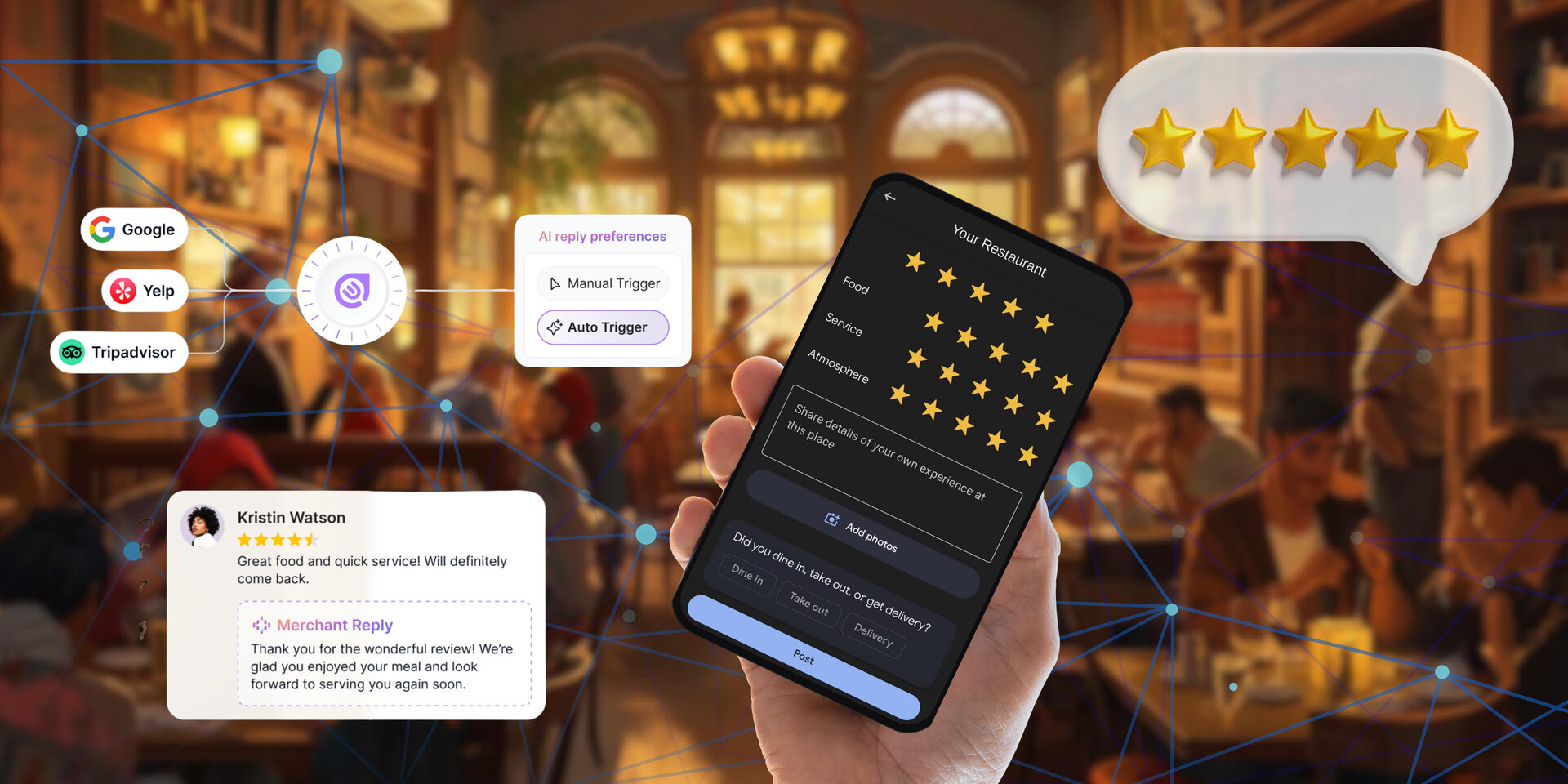
Your restaurant's reputation no longer begins at the host stand.
It begins the moment someone types "restaurants near me" and decides — in under ten seconds — whether your name is worth a tap. Star ratings. Recent reviews. How you respond. Whether you respond at all.
That first impression is shaped entirely by how you manage your online reputation. And for most independent restaurant operators, the honest answer is: not systematically enough.
Why This Actually Affects Your Revenue
Over 90% of diners read online reviews before choosing a restaurant. Nearly a third won't consider anywhere rated below four stars. Review freshness matters almost as much as the rating itself — a 4.8 average with six-month-old reviews signals less activity than a 4.4 with consistent recent feedback.
Response behavior is now a ranking signal too. Google factors engagement into local visibility. A restaurant that replies consistently outranks one that doesn't — even with a comparable rating.
What this means practically: review management isn't about damage control. It's about staying visible, staying current, and building the kind of consistent presence that makes guests choose you before they've ever walked through your door.
The question isn't whether to manage your reviews. It's which system actually works for an independent operator.
What's Out There — And Where Each One Falls Short
Most review management tools in the market today fall into one of two camps: platforms that help you get more reviews, and platforms that help you respond to the ones you already have. Very few do both well.
1. Owner.com
Owner.com has built its review management tool as part of a broader restaurant growth platform, tying review acquisition directly into their online ordering system. The logic is simple: more orders equal more review requests, which compounds into better Google rankings over time.
What owners love: The acquisition flywheel is genuinely effective. Post-order emails trigger automatically with a simple thumbs-up / thumbs-down prompt, routing positive sentiment to Google and catching negative feedback privately before it goes public. For restaurants already running Owner's ordering system, the whole thing runs in the background without manual effort.
What to watch out for: The entire system lives inside Owner's ecosystem. Guests who don't order through Owner's platform — dine-in, walk-ins, phone orders — never enter the funnel. There's no AI reply capability, so every response is still manual. Platform coverage is limited to Google, and there's no multilingual support, which matters for operators serving diverse customer bases.
Best for: High-volume restaurants already committed to Owner's ordering platform whose guests are primarily digital.
2. Chowbus
Chowbus approaches review management as a module inside its POS ecosystem, built primarily for multi-location brand operators rather than independent shops. Its defining capability is attribution — the ability to trace each review back to a specific order, dish, and staff member.
What owners love: For brand groups running multiple locations, the attribution depth is genuinely hard to replicate. Restaurant owners can identify which dishes generate the most positive mentions, which staff members consistently receive praise, and which locations trend downward before it shows up in aggregate rating. Automated review requests go out via digital and printed receipts, and negative feedback can be intercepted with incentive-based recovery options — a feature that most competitors don't offer.
What to watch out for: The attribution capability depends entirely on Chowbus POS being the source of truth, which means the entire module is inaccessible to operators using any other POS system. There's no AI-generated reply functionality, no multilingual support, and pricing isn't public — it requires a direct sales conversation.
Best for: Multi-location brand operators already running Chowbus POS who prioritize operational traceability.
3. Beyond Menu
Beyond Menu targets a specific and often underserved segment: independent Asian and Chinese restaurants looking for AI reply automation without enterprise-level pricing. Its Snap Reviews module leans heavily toward reply management, with some review acquisition capabilities layered in.
What owners love: The price point is accessible for independent operators, and the offline touchpoints — table tents, drop cards, NFC cards — give it an edge in capturing dine-in guests that digital-only tools miss. The AI reply workflow is functional, offering draft-and-publish or fully automated modes. It's a reasonable entry-level option for operators who just want something working quickly.
What to watch out for: Platform coverage stays primarily on Google, leaving Yelp and TripAdvisor largely uncovered. There's no proactive filtering to keep negative reviews private before they're published — complaints go live first, then get handled. Multilingual reply generation isn't available, despite the platform's stated focus on Asian restaurants. Some third-party reviews also raise concerns about account access practices and post-onboarding support quality that prospective buyers should research before signing on.
Best for: Independent Asian or Chinese restaurants on a tighter budget who want basic AI reply automation with some offline review capture.
4. BFN-AI
BFN-AI is the most narrowly focused product in this comparison: it only handles replies, not acquisition. But within that scope, it covers more platforms than anyone else — Google, Yelp, TripAdvisor, Trustpilot, and Booking.com.
What owners love: The pricing is fully transparent, which is rare in this market — tiered by monthly review volume with clear public rates. The ROI calculator on their website lets operators input their current review load and see projected time savings before ever talking to sales. Pre-launch brand voice training ensures AI responses match tone, and SEO keywords are embedded into replies along with subtle return-visit prompts.
What to watch out for: BFN-AI doesn't help you generate more reviews, which means it's only useful if your existing review volume is already strong. There's no negative review filtering — complaints go live before the system engages. The company is UK-based, pricing is in GBP, and there's minimal presence or case studies in the North American restaurant market. Most of their strongest proof points come from the hospitality sector more broadly, not restaurants specifically.
Best for: Operators with consistent existing review volume who need multi-platform reply coverage and value pricing transparency above all else.
5. Connexup
Connexup is built as a standalone reputation management system — not a feature bolted onto a POS or ordering platform. That means it works alongside whatever infrastructure a restaurant already has in place, without requiring any migration.
What owners love: Connexup is the only platform in this comparison that covers both sides of the review equation — acquisition and AI-powered reply management — in one system.
On the acquisition side, post-transaction outreach routes guests based on their experience, directing positive sentiment toward Google and Yelp while privately capturing negative feedback before it goes public.
On the reply side, every AI-generated response embeds SEO-relevant keywords and natural return-visit prompts, turning a routine thank-you into a low-friction marketing touchpoint. Coverage spans Google, Yelp, and TripAdvisor, with replies available for review before publishing or set to automated cadence.
Multilingual reply generation is native — something Owner, Chowbus, and Beyond Menu don't offer at all. Operational reporting also surfaces recurring themes across menu items, service, and staffing, turning reviews into structured business intelligence.
What to watch out for: Order-level attribution works well for most independent operators, but restaurants seeking staff-level tracking down to individual servers may want to evaluate whether that granularity fits their workflow. Offline touchpoints like table tents and NFC cards are available as optional add-ons rather than included by default. Pricing is tailored per restaurant rather than published publicly, so a conversation is needed to get an accurate quote.
Best for: Independent restaurants and emerging multi-location operators who need a complete, platform-agnostic system that handles both review acquisition and intelligent reply management, without switching ecosystems.
How the Five Platforms Compare
Here's how all five stack up across the capabilities that matter most for independent restaurant operators:
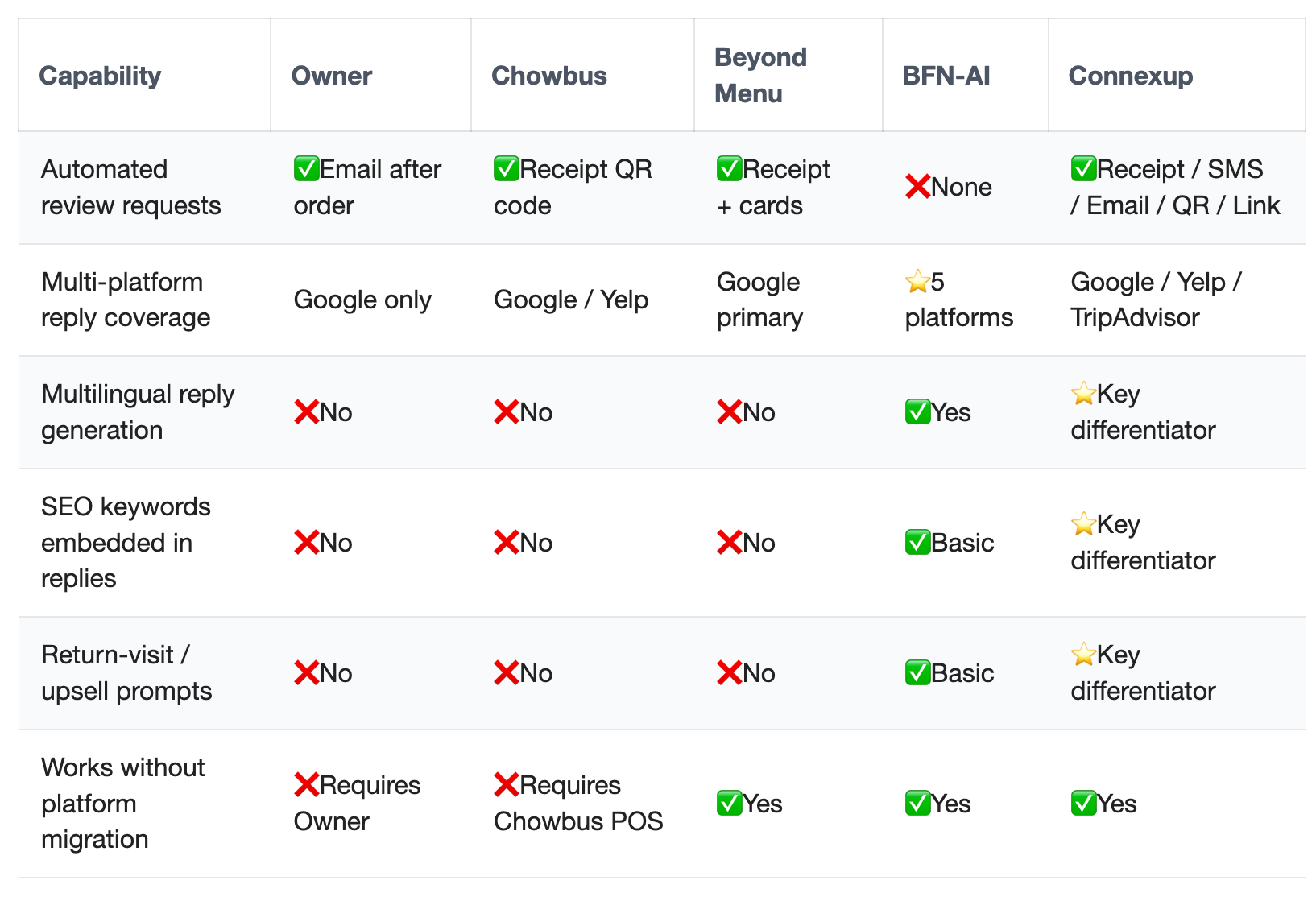
The pattern across all five is consistent: each solves part of the problem. The difference with Connexup is coverage — both sides of the review cycle, across platforms and languages, without requiring you to restructure your existing operations around new software.
Building a Reputation System That Works for You
The right approach to reputation management isn't about choosing the flashiest tool or the one with the most integrations. It's about choosing a system that fits how your restaurant actually operates — and that covers the full cycle, from generating reviews to responding to them, without requiring you to restructure your business around the software.
Your next guest may never visit your website. They'll meet your restaurant through a screen, a score, and a few lines of text. What they find there — and whether it reflects a restaurant that's actively engaged — determines whether they ever walk through the door.
Connexup is built around this exact need — giving independent restaurants a complete review management system that works across platforms, languages, and existing infrastructure, without forcing a switch to a new ecosystem. To learn more about the product or see how it works in practice, use the contact option below.