A Restaurant Website Is No Longer Just for Customers — It Shapes How You’re Found on Google
Connexup Team
Jan 5, 2026
For years, restaurant websites were treated as digital brochures: a place to list hours, upload a menu, and show a few photos. Today, that role has fundamentally changed.
Your website is no longer just something customers might visit.
It’s how search engines, maps, and recommendation systems decide whether your restaurant should be shown at all.
When diners search for food nearby, Google isn’t simply listing every option. It’s evaluating relevance, accuracy, and trust — then narrowing the field. The information it relies on most consistently comes from one place: your website.
In that sense, a restaurant website has become part of your operational infrastructure, not a marketing extra.
Visibility Is No Longer Guaranteed — It’s Evaluated
Ten years ago, having a Google listing and a few reviews was often enough to be discovered. Today, visibility is earned — and continuously re-evaluated.
Search engines look for signals that a business is:
Active and legitimate
Consistent across platforms
Easy to understand and categorize
Clearly differentiated from competitors
Restaurants without a structured, up-to-date website don’t disappear because they’re “bad.” They disappear because their information is fragmented, outdated, or difficult for systems to interpret.
And when that happens, algorithms don’t wait. They surface the next best option.
Why Third-Party Platforms Can’t Carry This Weight Alone
Marketplaces, delivery apps, and social platforms play an important role in discovery — but they were never designed to represent your business fully.
These platforms:
Control how your information is structured
Limit how your brand story is told
Change visibility rules without notice
Don’t build long-term authority for your restaurant
They help people find a restaurant.
They don’t help systems understand your restaurant.
Without a central, authoritative source of truth — your own website — search engines are forced to rely on partial data pulled from multiple places. That inconsistency directly impacts how often, and how confidently, your restaurant is recommended.
What Diners Actually Use Restaurant Websites For
Contrary to popular belief, most customers don’t visit restaurant websites to explore in depth. They visit to confirm.
They want to quickly answer questions like:
Is this place still open?
Is the menu current?
Does this feel legitimate and reliable?
Is this what I’m actually looking for?
When those answers aren’t immediately clear, customers don’t dig deeper — they move on.
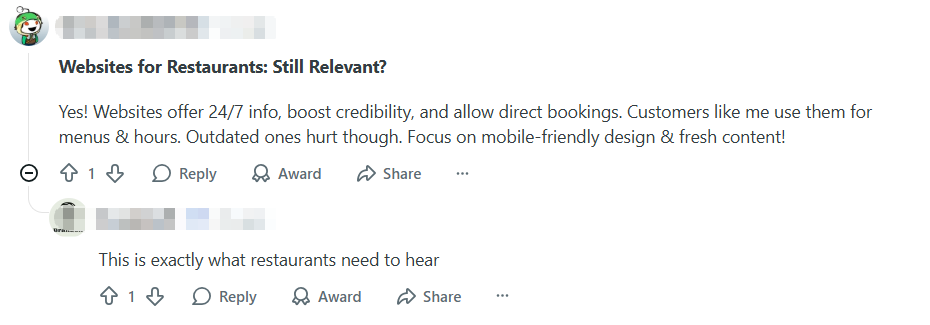
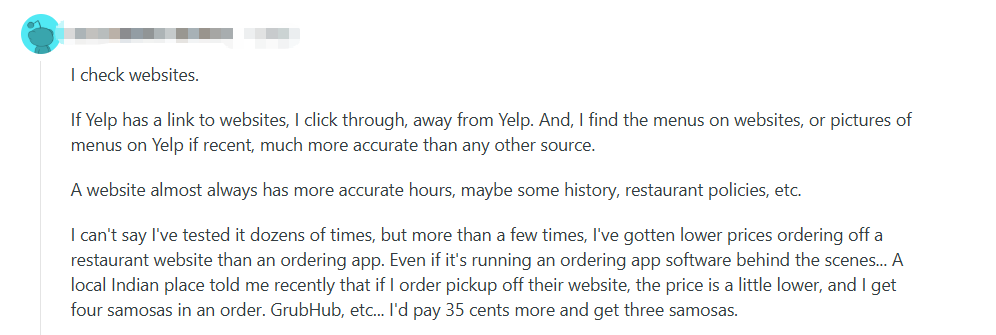 ——Reddit
Comments like this appear repeatedly across forums and review platforms. The behavior is consistent: websites are decision filters, not discovery tools.
That’s why clarity, accuracy, and structure matter far more than clever design.
The New Job of a Restaurant Website
A modern restaurant website needs to do three things well:
Communicate clearly with search engines
Structured content, SEO-friendly pages, and consistent data help algorithms understand your cuisine, location, and relevance.
Reduce friction for ready-to-decide customers
Menus, hours, locations, and ordering paths should be instantly accessible and always accurate.
Create recognizable differentiation
Your story, positioning, and brand identity signal why your restaurant deserves attention over others offering similar food.
This is no longer about “looking professional.”
It’s about being legible — to both people and systems.
Building a Brand Site That Search Engines Can Trust
This is where many restaurant websites fall short. They exist, but they aren’t designed to support visibility, accuracy, or growth.
Connexup Brand Site is built around a different premise: your website should actively support how modern discovery works.
Designed for Search Visibility
SEO-optimized site structure and content help search engines clearly interpret what you offer, where you’re located, and when to recommend you — turning Google searches into real foot traffic and orders.
Your Own Branded Domain
Your website lives on your domain, not under a platform subdomain. That means long-term authority, brand recognition, and control stay with you — not a third party.
Fast Setup, Easy Updates
Restaurants change constantly. Connexup makes it possible to launch in days, not months, and keep your site aligned with real operations without technical overhead.
Menu & Store Info Sync
Hours, locations, and menus sync directly from your Connexup dashboard, reducing inconsistencies that hurt both customer trust and search rankings.
Built Around Your Brand Story
With custom pages, blog content, and flexible design, your website reflects your restaurant’s identity — not a template. That differentiation isn’t just meaningful to customers; it’s also a signal algorithms recognize.
The Hidden Cost of Not Owning Your Digital Foundation
Restaurants don’t lose customers because they lack social media accounts. They lose customers because they lack a clear, trustworthy digital foundation.
Without it:
Visibility depends entirely on third parties
Search systems struggle to classify and recommend your restaurant(s)
Brand value never compounds
Every change creates new friction
A strong website doesn’t replace platforms — it stabilizes everything around them.
Stand Out Online. Grow Your Business. Build Your Brand.
In today’s search-driven landscape, a restaurant website isn’t optional — but it also shouldn’t be an afterthought.
When your site is built for visibility, accuracy, and brand clarity, it becomes more than a destination.
It becomes the foundation that search engines trust — and customers follow.
Connexup Brand Site helps restaurants turn online presence into real-world growth, without adding complexity to daily operations.
You may also want to read our related post:
Restaurant Reputation Management in a Google-First World